THE END
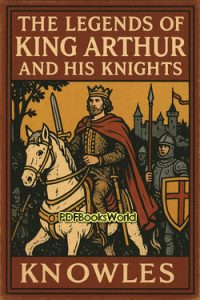
The Legends of
KING ARTHUR
and his
KNIGHTS
Sir James Knowles
Illustrated by Lancelot Speed
TO
ALFRED TENNYSON, D.C.L.
POET LAUREATE
THIS ATTEMPT AT A POPULAR VERSION OF
THE ARTHUR LEGENDS
IS BY HIS PERMISSION DEDICATED
AS A TRIBUTE
OF THE SINCEREST AND WARMEST RESPECT
1862
The Marriage of King Arthur
PREFACE TO THE EIGHTH EDITION
he Publishers have asked me to authorise a new edition, in my own name, of this little book—now long out of print—which was written by me thirty-five years ago under the initials J.T.K.
In acceding to their request I wish to say that the book as now published is merely a word-for-word reprint of my early effort to help to popularise the Arthur legends.
It is little else than an abridgment of Sir Thomas Malory’s version of them as printed by Caxton—with a few additions from Geoffrey of Monmouth and other sources—and an endeavour to arrange the many tales into a more or less consecutive story.
The chief pleasure which came to me from it was, and is, that it began for me a long and intimate acquaintance with Lord Tennyson, to whom, by his permission, I Dedicated it before I was personally known to him.
JAMES KNOWLES.
Addendum by Lady Knowles
In response to a widely expressed wish for a fresh edition of this little book—now for some years out of print—a new and ninth edition has been prepared.
In his preface my husband says that the intimacy with Lord Tennyson to which it led was the chief pleasure the book brought him. I have been asked to furnish a few more particulars on this point that may be generally interesting, and feel that I cannot do better than give some extracts from a letter written by himself to a friend in July 1896.
“DEAR ——,
“I am so
very
glad you approve of my little effort to popularise the Arthur Legends. Tennyson had written his first four ‘Idylls of the King’ before my book appeared, which was in 1861. Indeed, it was in consequence of the first four Idylls that I sought and obtained, while yet a stranger to him, leave to dedicate my venture to him. He was extremely kind about it—declared ‘it ought to go through forty editions’—and when I came to know him personally talked very frequently about it and Arthur with me, and made constant use of it when he at length yielded to my perpetual urgency and took up again his forsaken project of treating the whole subject of King Arthur.
“He discussed and rediscussed at any amount of length the way in which this could now be done—and the Symbolism, which had from his earliest time haunted him as the inner meaning to be given to it, brought him back to the Poem in its changed shape of separate pictures.
“He used often to say that it was entirely my doing that he revived his old plan, and added, ‘I know more about Arthur than any other man in England, and I think you know next most.’ It would amuse you to see in what intimate detail he used to consult with me—and often with my little book in front of us—over the various tales, and when I wrote an article (in the shape of a long letter) in the
Spectator
of January 1870 he asked to reprint it, and published it with the collected Idylls.
“For years, while his boys were at school and college, I acted as his confidential friend in business and many other matters, and I suppose he told me more about himself and his life than any other man now living knows.”
ISABEL KNOWLES.
ILLUSTRATOR’S NOTE
f scenes from the Legends of King Arthur and his Knights of the Round Table many lovely pictures have been painted, showing much diversity of figures and surroundings, some being definitely sixth-century British or Saxon, as in Blair Leighton’s fine painting of the dead Elaine; others—for example, Watts’ Sir Galahad—show knight and charger in fifteenth-century armour; while the warriors of Burne Jones wear strangely impracticable armour of some mystic period. Each of these painters was free to follow his own conception, putting the figures into whatever period most appealed to his imagination; for he was not illustrating the actual tales written by Sir Thomas Malory, otherwise he would have found himself face to face with a difficulty.
King Arthur and his knights fought, endured, and toiled in the sixth century, when the Saxons were overrunning Britain; but their achievements were not chronicled by Sir Thomas Malory until late in the fifteenth century.
Sir Thomas, as Froissart has done before him, described the habits of life, the dresses, weapons, and armour that his own eyes looked upon in the every-day scenes about him, regardless of the fact that almost every detail mentioned was something like a thousand years too late.
Had Malory undertaken an account of the landing of Julius Caesar he would, as a matter of course, have protected the Roman legions with bascinet or salade, breastplate, pauldron and palette, coudiére, taces and the rest, and have armed them with lance and shield, jewel-hilted sword and slim misericorde; while the Emperor himself might have been given the very suit of armour stripped from the Duke of Clarence before his fateful encounter with the butt of malmsey.
Did not even Shakespeare calmly give cannon to the Romans and suppose every continental city to lie majestically beside the sea? By the old writers, accuracy in these matters was disregarded, and anachronisms were not so much tolerated as unperceived.
In illustrating this edition of “The Legends of King Arthur and his Knights,” it has seemed best, and indeed unavoidable if the text and the pictures are to tally, to draw what Malory describes, to place the fashion of the costumes and armour somewhere about A.D. 1460, and to arm the knights in accordance with the Tabard Period.
LANCELOT SPEED.
 Library